Jane Kirkpatrick: Come Visit the World in Oregon
 Have
you ever been to Rome...Oregon? People from around the world converge on this
tiny town because float trips on the Owyhee River begin at Rome. To take that
trip is to step back in time as the river meanders through rock pillars that
look as much like Utah or Yellowstone as eastern Oregon.
Have
you ever been to Rome...Oregon? People from around the world converge on this
tiny town because float trips on the Owyhee River begin at Rome. To take that
trip is to step back in time as the river meanders through rock pillars that
look as much like Utah or Yellowstone as eastern Oregon.
 I’m
intrigued by Oregon’s many towns named for places better known somewhere else.
As I write historical novels based on the lives of actual women and men, it
interested me that so many Eastern/Anglo names of towns speckle Oregon’s
landscape while our northern
I’m
intrigued by Oregon’s many towns named for places better known somewhere else.
As I write historical novels based on the lives of actual women and men, it
interested me that so many Eastern/Anglo names of towns speckle Oregon’s
landscape while our northern
neighbor, Washington, hosts dozens more mountains,
cities, creeks etc. that bear native names. In researching frontier diseases, I
learned that the malaria mosquito that arrived on the Columbia River on “Boston
ships” of the 1870s, never crossed the Columbia into Washington. Instead, the
mosquitos afflicted the vulnerable tribes of Oregon. My theory is that when
settlers arrived in the 1840s, there were few Indians left to say what that
river or mountain was called. So white settlers named the places from their
traditions, reminders of “back home.”
 One
of the rivers that does bear an Indian name is the Coos River on the southern
coast. I invite you to Charleston — Oregon. Near-by is beautiful Shore Acres
State Park overlooking the Pacific. My book A Gathering of Finches tells
the story of the woman who inspired the creation of that park. You can stay in
a B & B in Charleston on your way to enchantment visiting the five acres of
formal garden that Cassie Simpson’s husband created for her.
One
of the rivers that does bear an Indian name is the Coos River on the southern
coast. I invite you to Charleston — Oregon. Near-by is beautiful Shore Acres
State Park overlooking the Pacific. My book A Gathering of Finches tells
the story of the woman who inspired the creation of that park. You can stay in
a B & B in Charleston on your way to enchantment visiting the five acres of
formal garden that Cassie Simpson’s husband created for her.
How could I not talk about Portland — Oregon? Years ago,
when I worked with families whose children had disabilities, a story was told
of a Portlander visiting a classroom of Downs Syndrome children in Sweden. “Are
you from the Portland on the east coast or the Portland on the west coast?”
asked this preschooler shattering the then held view that Downs Syndrome
children could not learn. Those Swedish kids knew of two Portlands and where
they were in the United States. Oregon’s Portland is at the confluence of the
Willamette and the mighty Columbia Rivers. In my latest novel Everything She
Didn’t Say, Portland plays a part. But so do cities and rivers across the
west as the subject of this book — Carrie Strahorn — traveled for twenty-five
years with her husband developing railroad opportunities and actually building
cities in the west. Portland was an important hub for railroad development and
Carrie in her 1911 memoir Fifteen
Thousand Miles By Stage wrote of that city and rivers that flow through
Oregon’s history and our very contemporary lives. (sign up for a chance to win
one of two copies of that book out in September at my site.)
Leave a comment here to win a copy of this new release! Jane offers this great prize to 2 lucky
winners!
Please
come to Oregon and visit Dallas and St. Louis and Jacksonville and oh, so many
more cities whose history comes from the east but lives on in the west — and
most of those places have a creek or a river that runs through them and are
lovely to sit beside.
Jane is internationally recognized for her
lively presentations and well-researched stories that encourage and inspire.
A New York Times Bestselling
author, her works have appeared in more than 50 national publications including
The Oregonian, Private Pilot and Daily Guideposts. With more than 1.5 million
books in print, her 30 novels and non-fiction titles draw readers from all ages
and genders. Most are historical novels based on the lives of actual historical
women often about ordinary women who lived extraordinary lives. Her works have
won numerous national awards including the WILLA Literary Award, the Carol
Award, USABestBooks.com, Will Roger's Medallion Award and in
1996, her first novel, A Sweetness to the Soul, won the prestigious Wrangler
Award from the Western Heritage and National Cowboy Museum. Her novels have
also been finalists for the Spur Award, the Oregon Book Award, the Christy,
Reader's Choice and the WILLA in both fiction and non-fiction. Several titles
have been Literary Guild and Book of the Month choices and been on the
bestsellers list for independent bookstores across the country, in the Pacific
Northwest and the Christian Booksellers Association. Her books have been
translated into German, Dutch, Finnish and Chinese.
Helen
Picca: Oregon- an Incredibly Diverse State
Diverse geologically and climatically. It is a rather large state, ranking 9th
overall in land size, but much further down the scale in terms of
population. We rank 27th in
population, but 40th in population density—that’s 39.9 people per
square mile!
Along the I5 Corridor, a major west coast interstate, lie
the big cities: Portland, an
eco-friendly city and home to the Portland Trailblazers, the Japanese Gardens
and the International Rose Test Garden, containing over 10,000 roses; Salem,
the capital city set amid parks and gardens, featuring the Ale and Cider Trail;
and Eugene, a college town, known as “A great city for the arts and
outdoors.”
 East of that major artery are the Cascades, a mountain
range of extraordinary peaks extending from Mt Shasta in northern California
all the way to British Columbia, Canada, with 11 peaks over 8,000 ft in
Oregon.
East of that major artery are the Cascades, a mountain
range of extraordinary peaks extending from Mt Shasta in northern California
all the way to British Columbia, Canada, with 11 peaks over 8,000 ft in
Oregon.
Within that range
lies Crater Lake, the deepest lake in the USA, and perhaps the most
pristine. Almost 2000 ft. deep, this
bluer-than-blue lake within the crater was formed when Mt. Mazama blew its top
and it is the only National Park within the state.
Further east of the mountains, lies dry, flat plains that
are desert, and high desert filled with manzanitta bushes and majestic
Ponderosa pines, and not very many people.
There are mostly small towns, remnants of frontier outposts that
supported cattle ranchers, many ranches still active today.
But on the west side of the Cascades is a whole other
environment—the lush valley, where much of the state’s agriculture is grown and
on out to the very edge of the continent, to the Oregon Coast. Otherwise known as “The People’s Coast,”
where the beaches are designated as public land.
The coastline is dotted with fishing and resort
communities from Seaside in the north to Harbor in the south, all 363 miles of
rugged coastline, where monolithic rocks—called sea stacks—can be spotted all
along the ride on U.S. Highway 101, the scenic coastal road. This scenic byway
is one of the most famous in the United States and is a tourist attraction in
itself. For more information see the
brochure at https://visittheoregoncoast.com/pdf/OCVA_PCSBBrochure.pdf
Yes, it rains a lot seven to eight months a year, but the
rest of the year is gloriously sunny and, with a fairly constant ocean wind, is
mildly temperate—80 degrees would be considered a heat wave!
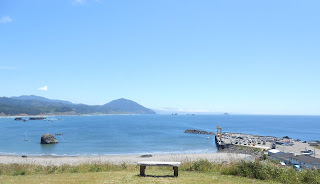 The southern coast of Oregon, Curry County, is where I
call home and where I was inspired to write.
Several years ago, I was sitting on a bench in the town of Port Orford,
overlooking the Pacific Ocean, taking in the scene before me: a working fishing
dock, majestic rock heads to my right and to my left nothing but trees, green
evergreen forests as far as my eye could see, near to the California border.
The southern coast of Oregon, Curry County, is where I
call home and where I was inspired to write.
Several years ago, I was sitting on a bench in the town of Port Orford,
overlooking the Pacific Ocean, taking in the scene before me: a working fishing
dock, majestic rock heads to my right and to my left nothing but trees, green
evergreen forests as far as my eye could see, near to the California border.
There were no houses,
no golden arches, no big box stores.
Just nature—the sea, the forest, the mountains of the coastal
range. I was transfixed by its raw
beauty when I was struck with an idea, loud in my head, “write a book about
Port Orford.” That was the start of my
writing career.
In “The Last Frontier
of the Fading West,” a work of historical fiction, I tried to capture the sense
of this small fishing community, where everyone knows each other. With a population of 1190 in 1.56 square
miles, small may be an understatement. I
started by researching the town and the county and discovered a little-known
fact that this town was the place where survivors were brought when an oil
tanker was sunk by a Japanese submarine during WWII. I knew that was where my story would begin…
“I
remember it like it was yesterday—the chaos, the fear, the uncertainty. . .the
first time I saw him. The immediate
attraction, that queasy, sort of stomach-turning sensation that set me all
aflutter. I was young—so young—naïve,
isolated in a small world of safety and comfort too soon shattered by a phone
call.”
One of the things I truly love about living here on the
southern Oregon coast are the hiking trails.
Nowhere else that I have found can one hike all alone, not see another
human being, and find patches of wild berries to gorge upon, like
Thimbleberries
or Huckleberries
With enchanted forests, misty fern grottoes and breathtaking ocean
views, one can escape to serenity, where the imagination can run free.
For more information go to:
 It was in this environment, so pristine and bucolic—where
I can ride down the highway and see fields of cows and sheep, pass countless
blueberry and cranberry farms (and very few cars)—that I was able to forge my
path to happiness. Here, I was inspired
to write my story, of my life
getting on and running on the hamster wheel and going nowhere. Then, getting
off, searching for greater meaning in life, to finding peace and contentment.
In other words, happiness. From New York to Hawaii to Oregon, the first part of
this book is memoir, recounting a life not fully
lived; the second part contains 10 aspects of life I worked on, the 10 Easy
Steps, that led me to the ultimate goal of happiness.
It was in this environment, so pristine and bucolic—where
I can ride down the highway and see fields of cows and sheep, pass countless
blueberry and cranberry farms (and very few cars)—that I was able to forge my
path to happiness. Here, I was inspired
to write my story, of my life
getting on and running on the hamster wheel and going nowhere. Then, getting
off, searching for greater meaning in life, to finding peace and contentment.
In other words, happiness. From New York to Hawaii to Oregon, the first part of
this book is memoir, recounting a life not fully
lived; the second part contains 10 aspects of life I worked on, the 10 Easy
Steps, that led me to the ultimate goal of happiness.
When
was the last time you asked yourself, “Am I happy?” Do you feel like you are
running on a hamster wheel and going nowhere? This practical 10-Step guide
offers a way to jump off the wheel, slow down and experience a more fulfilling
life.
Brimming with wry humor and insightful
anecdotes, here is Picca’s personal odyssey--a search for greater life
satisfaction. Within these pages lies a proven path to a state of peacefulness
and genuine contentment. You, too, can abandon the futile hamster wheel, add
meaning to your life, and find lasting happiness. Are you ready to be happy?
Please comment below, letting me know if you’ve ever been
to Oregon and do tell me where you live.
One lucky reader will receive a signed copy of “The Last Frontier of the
Fading West.” (Sorry, US only)
H.L.
Wegley Brings Oregon-Land of the Golden West:
My wife and I were both raised in the same community in
Oregon. In our day, every school kid learned the Oregon state song, Oregon, My Oregon. The first line ends
with the words, “land of the golden west.” But the second verse calls Oregon,
“land of the setting sun,” for good reason.
 The Oregon Coast boasts some of the most spectacular
sunsets in the world. Despite the muddy picture that mid-winter on the Oregon
coast conjures up, it’s a great time for sunshine, between rainstorms of
course. Here’s what the January sun can produce at Lincoln City.
The Oregon Coast boasts some of the most spectacular
sunsets in the world. Despite the muddy picture that mid-winter on the Oregon
coast conjures up, it’s a great time for sunshine, between rainstorms of
course. Here’s what the January sun can produce at Lincoln City.
The Cascade Mountains, separating Eastern and Western
Oregon, are lined with spectacular volcanic peaks. Mount Hood is the most
prominent.
Further
south, outside the tourist town of Sisters, are three sibling peaks known as,
what else, the Three Sisters. In the
clear air of Eastern Oregon, the sisters are visible from 50 to 60 miles away.
The picture of the Three Sisters was taken from Paulina Peak, near Lake
Paulina, 60 miles from the farthest sister.
The Deschutes River flows northward along the eastern
slopes of the Cascades. This river provides the best steelhead fishing in the
world and hosts its own brand of cascades, such as Steelhead Falls.
Sometime soon, I’m
going to set a scene at the falls. It looks like a great place to get shot at …
well, if they don’t hit you.
North of Bend Oregon, near the small town of Terrebonne,
the deep canyon of the Crooked River cuts through the desert for 125 miles.
This miniature Grand Canyon provided the setting for part of the classic 1967
western movie, The Way West, in which
Sally Field made her movie debut. The view from the canyon rim is stunning, but
sometimes a bit hazy during the summer when wildfires sometimes create a smoky
haze.
On a plateau along the Crooked River, avid golfers will
find one of the best kept golfing secrets in the United States, an incredibly
beautiful course with magnificent vistas. Irrigation makes the Crooked River
Ranch Golf Course, which lines the canyon, an oasis in the desert.
Brave golfers can try
to drive across part of the canyon to shave a stroke or two off their score. If
a golfer comes up short, regrets are as deep as the canyon (400 - 500 feet).
Just drop another ball and take your penalty strokes. You aren’t gonna’ find
your dimpled darling. It’s gone!
 My latest novel, No
True Justice, uses Lake Billy Chinook, near Madras, Oregon for several
action-filled scenes. The lake, formed by Round Butte Dam at the confluence of
the Deschutes, Crooked, and Metolius Rivers, meanders through canyons, some
lined by 500- to 800-foot-high cliffs. It’s a bad place to be caught when a
helicopter approaches with a black ops team using RPGs to take you out. Oops.
That was a bit of a spoiler. Or maybe a teaser. Regardless, Lake Billy Chinook
provides some panoramic views of Mount Jefferson.
My latest novel, No
True Justice, uses Lake Billy Chinook, near Madras, Oregon for several
action-filled scenes. The lake, formed by Round Butte Dam at the confluence of
the Deschutes, Crooked, and Metolius Rivers, meanders through canyons, some
lined by 500- to 800-foot-high cliffs. It’s a bad place to be caught when a
helicopter approaches with a black ops team using RPGs to take you out. Oops.
That was a bit of a spoiler. Or maybe a teaser. Regardless, Lake Billy Chinook
provides some panoramic views of Mount Jefferson.
 The main verse of the Oregon State Song ends with, “Hail
to thee, Land of the Heroes, My Oregon.” I would have to add “land of
heroines,” because some of the finest hours of any heroine in print are lived
in my four novels set in this great state. Of course, I’m not a bit biased.
The main verse of the Oregon State Song ends with, “Hail
to thee, Land of the Heroes, My Oregon.” I would have to add “land of
heroines,” because some of the finest hours of any heroine in print are lived
in my four novels set in this great state. Of course, I’m not a bit biased.
 If you leave a comment, you’ll be entered into a giveaway for my recent release, No True Justice. It is set in Oregon
near 5 of the 7 pictures in this post. This romantic suspense tells the story
of Gemma Saint, a young woman coerced into WITSEC to silence her as part of a
conspiracy to influence a presidential election. You can read more about this
story, including 4 chapters, here: https://www.amazon.com/gp/product/B07FLLW3DJ/ or
you can visit my author page: http://www.hlwegley.com and
look under the Books tab for the Witness Protection Series.
If you leave a comment, you’ll be entered into a giveaway for my recent release, No True Justice. It is set in Oregon
near 5 of the 7 pictures in this post. This romantic suspense tells the story
of Gemma Saint, a young woman coerced into WITSEC to silence her as part of a
conspiracy to influence a presidential election. You can read more about this
story, including 4 chapters, here: https://www.amazon.com/gp/product/B07FLLW3DJ/ or
you can visit my author page: http://www.hlwegley.com and
look under the Books tab for the Witness Protection Series.

 In
the early 1800s, Oregon Territory ran from the Rocky Mountains to the Pacific
and from what is now the Canadian border south to Alta California which
today is Northern California. Fur
trappers followed Lewis and Clark harvesting hides for the Asian market and
they often worked their way down the Willamette Valley into Northern
California. This area was named because the trappers of Oregon were mostly
French Canadians who wintered in that milder climate. In my Tender Ties Series,
Marie Dorion, an Iowa Indian woman who was the only woman in the Astor
expedition, remained in what became Oregon.
Documents of the fur trappers include mention of her husband and her
being in French Camp, California, too. (A
Name of Her Own). Those trappers found a warm welcome in California and the
locals enjoyed trading for goods brought south.
In
the early 1800s, Oregon Territory ran from the Rocky Mountains to the Pacific
and from what is now the Canadian border south to Alta California which
today is Northern California. Fur
trappers followed Lewis and Clark harvesting hides for the Asian market and
they often worked their way down the Willamette Valley into Northern
California. This area was named because the trappers of Oregon were mostly
French Canadians who wintered in that milder climate. In my Tender Ties Series,
Marie Dorion, an Iowa Indian woman who was the only woman in the Astor
expedition, remained in what became Oregon.
Documents of the fur trappers include mention of her husband and her
being in French Camp, California, too. (A
Name of Her Own). Those trappers found a warm welcome in California and the
locals enjoyed trading for goods brought south. A
few years later, as families began exploring the west, the first group hoping
to bring wagons through the Sierra Nevada in 1844 found themselves snowed in at
what today is Donner Lake, named for a tragedy two years later. The Stephens-Murphy-Townsend wagon train got
stuck there first. They made different decisions and the party split up. Eight
women, one man and 17 children were stalled in eight feet of snow at the head
of the Yuba River in California and it was Oregon Mountain men who arrived at
Sutter’s Fort in Sacramento and who had the gear, energy and heart to head into
the Sierras to attempt the first rescue. My latest novel (One More River to
Cross) is based on that incredible journey of Canadians and Missourians
including two babies headed into the challenges of California.
A
few years later, as families began exploring the west, the first group hoping
to bring wagons through the Sierra Nevada in 1844 found themselves snowed in at
what today is Donner Lake, named for a tragedy two years later. The Stephens-Murphy-Townsend wagon train got
stuck there first. They made different decisions and the party split up. Eight
women, one man and 17 children were stalled in eight feet of snow at the head
of the Yuba River in California and it was Oregon Mountain men who arrived at
Sutter’s Fort in Sacramento and who had the gear, energy and heart to head into
the Sierras to attempt the first rescue. My latest novel (One More River to
Cross) is based on that incredible journey of Canadians and Missourians
including two babies headed into the challenges of California.

 Social
movements also found bonds between the two states with interaction during
suffrage efforts and beyond.
Social
movements also found bonds between the two states with interaction during
suffrage efforts and beyond. Jane
Kirkpatrick is the author of 33 books mostly historical novels based on the
lives of actual historical women or incidents. She’s a NY Times Bestselling
author and winner of numerous awards and starred reviews from Publisher’s
Weekly and BookList. Her latest novel, One More River To Cross will release
September 3. Jane lives with her husband Jerry and one Cavalier King Charles
Spaniel near Bend, OR.
Jane
Kirkpatrick is the author of 33 books mostly historical novels based on the
lives of actual historical women or incidents. She’s a NY Times Bestselling
author and winner of numerous awards and starred reviews from Publisher’s
Weekly and BookList. Her latest novel, One More River To Cross will release
September 3. Jane lives with her husband Jerry and one Cavalier King Charles
Spaniel near Bend, OR.