Begin
with Carole Ann Moleti: New York City's Urban Gardens Have
Interesting Stories To Tell
I'm delighted to be back this year to talk about New York.
Sometimes I talk about upstate and sometimes downstate, but my hometown won out
this year.
When people hear about gardens in New York City, they think
about Central Park and the three Botanical Gardens (Bronx, Brooklyn, and
Queens) not so much about smaller green spaces tucked into unusual places.
Urban gardeners have a lot to contend with, and so do urban gardens.
Sunlight is blocked by big buildings, tree roots get choked by concrete,
watered as much by dogs as by clouds, and trampled by traffic--vehicle and
human alike. But like New Yorker's, they fight for life--and there are a lot of
New Yorkers who fight for their gardens.
Schools are incorporating gardening into curriculums to help
teach students about sustainability, ecology, and healthier eating. This is the
community garden at a South Bronx high school, which are in raised beds due to
high levels of lead and other pollutants in the soil.
For several years, I've joined co-workers for an annual day
of service to pay our respects to one of ours who tragically lost her life in a
bicycle accident. We gather in different spots along the Bronx River Greenway.
It's amazing miles of parkland that have managed to survive, and thrive the
creation of the Bronx River Parkway that runs parallel to it, the high rise
apartment buildings and factories that border it on both sides, and the
multiple overpasses that carry car, truck and train traffic spewing their
exhaust down its banks.

This northern end has fared better that the southern, but
efforts are continuing and things are getting better. Each year, our team of
eager volunteers is met by rangers from the Bronx River Alliance, who escort
us, shovels in hand, to a different area to help with reforestation efforts. There
is always a lot of debris to clean up as well, most of it from people who are
enjoying the park a little too much, leaving behind bottles, cans, food waste
other pocket debris-keys, condoms, loose change. Drug paraphernalia is
uncommon, but we've unearthed it. One team cataloguing trash in the river last
year found a pig carcass. It always gives me great pleasure to leave behind a
clean, path with hundreds of new trees, ninety percent of which do survive,
unless someone comes along to steal them once we're gone.

This year, a team of ninety volunteers carried three to six
foot trees into the Bronx River Forest and dug through mesh put down a few
years ago to control invasive weeds. The challenge was working on a steep bank,
a few feet from the guardrail of the southbound Bronx River Parkway with cars
whizzing by. And what story this riverbank had to tell. I could only imagine
how that car had smashed into that guardrail and careened down the bank,
knocking down trees along its path. Having ridden ambulances, I knew how the EMT's
had worked on the driver or passenger who'd been wearing the plaid wool jacket.
Standing on the same place as I was, they'd stabilized and transported him to
the hospital. As I pulled pieces of the car out of a pile of dirt--a gas cap,
the twisted remains of a metal wheel rim, shards of red glass from the brake
lights, I wondered if the naloxone packet, found with the sunglasses, meant it
had happened in the daytime, and if a drug overdose caused the accident.


It was all removed, and we left behind the closest thing to
a pristine state The Bronx River Forest will ever know. Walking out we passed a
group having a picnic with several cases of beer and shopping bags full of food
all around them. In deference to our presence, or because of it, they sat
quietly on the riverbank, trash neatly packed up, enjoying a beautiful late spring
day in an urban oasis. Just like it should be.
Bio:
Carole Ann Moleti lives and works as a nurse-midwife in New
York City, thus explaining her fascination with all things paranormal, urban
fantasy, and space opera. Her nonfiction focuses on health care, politics, and
women's issues. But her first love is writing science fiction and fantasy
because walking through walls is less painful than running into them.
Carole's work has appeared in a variety of literary and
speculative fiction venues Short stories set in the world of her novels are
featured in several of the Ten Tales
anthologies. The Unfinished Business
Series, a three volume paranormal romance, was published by Soulmate.
Links:
And Fabulous Kenneth Weene: Meeting
Ike-a New York Memory
 The
first time I lived in New York—for three years—was a difficult period in my
life, a time I’d prefer to forget. While I was nominally studying International
Education at Columbia University, most of those years were spent studying
Greenwich Village coffee houses and the inner workings of my own depression, a
depression at least in part fueled by my cousin’s suicide.
The
first time I lived in New York—for three years—was a difficult period in my
life, a time I’d prefer to forget. While I was nominally studying International
Education at Columbia University, most of those years were spent studying
Greenwich Village coffee houses and the inner workings of my own depression, a
depression at least in part fueled by my cousin’s suicide.
His
death and my depression find expression in my novel Memoirs From the Asylum. Did you know that writing can be good
therapy? Yes, it can. Other bits and pieces of those years can be found in my
other writing, but for the most part I have left them untouched—far too
painful.
Still,
there was one day that stands out. It was a Friday. The weather was good for
November, warmer than normal. I had blown off classes that morning, but not for
the usual reason; I wasn’t sleeping in. I was having breakfast with one of the
few people in the world whom I admired enough to get me out of my upper-Harlem
apartment before noon. Ex-President Dwight David Eisenhower was the guest of
honor at International House, the only organization I had joined during the
previous year at Columbia. I had grown up revering Ike, especially since my
grandfather worshiped him. “He saved us from Hitler,” Pa would tell me. “And,
he brought you Uncle Harry home safe and sound and with a medal, a Bronze
Star.”
When
else would I meet Pa and my hero?
Showered,
dressed—nicely, not my usual disheveled self—I got into the coffinesque
elevator that serviced the seven-story building and slowly squeaked to the
ground. Leaving the red brick fortress, I turned right and then right again
onto St. Nicolas Ave. I stopped for a minute to say good morning to Dave, who
ran the corner store that sold newspapers, cigarettes, snacks, and egg creams.
Then, nodding to the subway and looking up at the beautiful sky, I started
walking south. It would take about half an hour to walk, which would get me to
my destination well ahead of the scheduled brunch.
As I
walked the busy, dirty streets of the city, I thought how much better it would
be were there a friend meeting me to share the event. Sadly, I had almost no
acquaintances let alone friends. Depression makes for loneliness and loneliness
adds to depression: one of life’s vicious circles. Still, fate has its little
jokes. That day I ran into Joyce, one of the few people I did know at Columbia.
She
hurried up. “Ken, I need to talk with you. I need your help.”
The last thing I wanted was to help anyone. “Sorry, I’m on my way to meet Ike,”
I said—not feeling important nor trying to impress but wanting her to know I
had no choice.
“Wow! Really?!”
Hurriedly,
I explained about the brunch. “Too bad I can’t bring you with me,” I added with
mixed feelings as I turned away.
“That’s
okay. But, after. Could you do me a favor?”
“I don’t know when—”
“Whenever.
I just need you to take a test. I’ve got to get some volunteers. I’m taking
this IQ testing course. Just come by my room when you finish.” Joyce lived in
the dorms, something I would never do.
I’m a
sucker for pleading voices, especially pleading women’s voices. “Okay. See you
later.”
So, that was the day I met Ike. He was warm, charming, and as circumlocutious
in person as he was on television. We shook hands. I wanted to tell him about
my grandfather and standing on the sidewalk with Pa waiting for his motorcade
when he was running for the presidency. I didn’t have a chance. We were herded
through the reception line and seated. Ike had a few bites, drank what I assume
was coffee, and was introduced.
His
speech was pure Eisenhower, certainly not brilliant rhetoric but an affirmation
of the importance of international amity.
We
applauded. He waved, smiled, and sat down. I turned back to my Danish—blueberry
if I recall—took a bite, looked up, and Ike was being spirited out of the room.
Nobody knew why. The room buzzed with hypotheses and disappointment.
Without
the guest of honor, the event ended quickly. I had hoped it would be later,
late enough that I’d have an excuse to give Joyce for not showing up.
Damn, I might as well.
Joyce
had set up a bridge table in the bay window which allowed a view of the busy
street three stories below us. On a smaller table to one side sat the boxes of
manipulables that made up the performance section of the Wechsler. The
scoresheet, sharpened pencils and manual neatly set out in front of the chair
in which she sat as she gestured me to the one opposite.
At this
point my memory grows hazy. Of course, I know that test well. I’ve given it
hundreds of times. And, from Joyce’s response at the end, I’m sure I did my
usual: I’m great at IQ tests. Living may be another question.
It was
almost two hours later that I left Joyce’s room. As I walked the few steps from
the building’s front door to the sidewalk, I was struck by a change. The
brightness of the day had somehow turned somber. People looked down, not with
the hurried step of a normal New York day but with a sobriety and slowness. It
was as if the city had been enveloped in a cloud. I turned back, thinking I
might go back inside to Joyce’s room. No reason there. No good it could do.
 As I
walked towards Broadway, I saw knots of people in serious discussion. Again,
something not typical of New York, not even in the university’s neighborhood.
New York is a place of hustle, bustle, and isolation.
As I
walked towards Broadway, I saw knots of people in serious discussion. Again,
something not typical of New York, not even in the university’s neighborhood.
New York is a place of hustle, bustle, and isolation.
Could the city have caught my depression? I inched closer to one of the small
gatherings. They were sharing disbelief, loss, confusion.
“What’s happened?” I asked. I was prepared to hear that war had broken out. Had
we once again tried to overthrow Castro? Had the Navy fired on Chinese ships?
Has—?
“You haven’t heard? Kennedy, he’s dead. Somebody assassinated the President.”
Years later, when I took up writing poetry, one of the first pieces I had
published referenced that day and the great sense of loss that was the Cold
War. It was titled:
Memorial
for My Grandfather, Ike, and Wartime Dead:
Hours spent—leaning on his cane grandfather waited—warm sun of autumn
chill—procession stretching up the hill in slow camera motion—wave to him a
hero—wave—head bobbing in recognition of unknown sons—medals earned—where?
Bastogne’s now-filled woods boots worn
thin, cold, bleeding feet bronze valor row on white row on.
Long
tubes—assembled in Watertown—to hurl projectiles filled with furies across
rebuilding the Germanies to kill poles, Czechs, Ukrainians—insured democracies
on scorched technology.
Uncle, he had been too old, marveled until
his hippie son cried being very young and terrified.
 He
never sought gainful employment something more than beaches open for the summer while we
marched—red capes and felt hats—along the Broadway passed grandfather’s empty house
in nodded recognition but how would I have voted?
He
never sought gainful employment something more than beaches open for the summer while we
marched—red capes and felt hats—along the Broadway passed grandfather’s empty house
in nodded recognition but how would I have voted?
I met
him years later brunch incoherent speaker the day when John-John cried.
Coincidence?
—We waved—in slow camera motion as you came long procession stretching up the
hill and grandfather leaned on his cane to wave and told stand small boy
straight for heroes who had fought those living and those dead and grandfather
for whom I dread filled cried as in band wool we marched by, good-bye.
Novelist, essayist, and poet, Ken Weene returned to New
York a few years later and lived there until 2002 when he moved to Arizona. You
can find more about his and his work at www.kennethweene.com
Ken offers a giveaway copy
of Times to Try the Soul of Man to one person who comments here!
With a Finale by Deborah Garland: The North Remembers-Clarifying Long Island, NY’s
Coastal Communities
The North Fork
that is. Or is it the North Shore?
If you don’t live on Long Island, it becomes a “What’s in
a name” game. Is there really a difference?
A publishing house in California didn’t think there was,
when they rejected my book series ultimately because they felt it conflicted
with another series that was set in the same location.
Only it wasn’t. Not really. The other series took place
on the North Shore. My romance series is set in the fictional town of Darling
Cove on the North Fork. Wine country. But from three thousand miles away, it
was an understandable mistake to make. Except it cost me a book deal with a
publisher I’d been dying to work with.
So let’s set the record straight about what is really
going on, on Long Island. For
starters, it’s not an island.
 That is always the biggest misconception. One thing they
got right in the name, it is definitely, LONG.
Even Wikipedia doesn’t fully understand its borders. It states Long
Island is 118 miles from New York Harbor to Montauk Point. New York Harbor is
west of Manhattan.
That is always the biggest misconception. One thing they
got right in the name, it is definitely, LONG.
Even Wikipedia doesn’t fully understand its borders. It states Long
Island is 118 miles from New York Harbor to Montauk Point. New York Harbor is
west of Manhattan.
What some people may not also know is that Long Island is
divided between two counties-Nassau and Suffolk. And it’s clear these counties are not divided
equally. In fact, Nassau County is so much smaller. Again, someone looking at
this may not even think, Nassau County is part of Long Island. It is. The
majority of Long Island is Suffolk County.
 And it’s the location of our two Norths. So why should
two communities that are less than fifty miles apart be classified so
differently? In wide open spaces, fifty miles probably doesn’t mean much but in
metropolitan areas, it can be a different world.
And it’s the location of our two Norths. So why should
two communities that are less than fifty miles apart be classified so
differently? In wide open spaces, fifty miles probably doesn’t mean much but in
metropolitan areas, it can be a different world.

I wouldn’t go so far as saying the North Shore is a
different world from the North Fork. I’ll start by saying I live on the North
Shore. So I can say from personal experience to know it’s different enough from
the North Fork. To understand where the North Fork is, it’s important to
understand what the North Fork really is. And why it’s so wonderful.
As seen in the maps, Long Island ‘forks’ north and south.
The south east region is called the South
Fork. Collectively, they are known as the Twin Forks. Are you horribly
confused yet? For purposes of this post,
we will concentrate on the North. Not that the South Fork isn’t interesting. It
is the home of the famous “Hamptons”. Nearly everybody’s heard of the Hamptons
and perhaps can find it on a map.
The main draw of the North Fork, and why I love it so
much and why I wanted to set my romance novel there is because it’s wine
country! In the summer, you can splash around in the calm waters of the Long
Island Sound. In the spring, stop at a fruit stand. In the fall, I bundle up
and go pumpkin picking. The topography of the landscape is mostly
farmland.
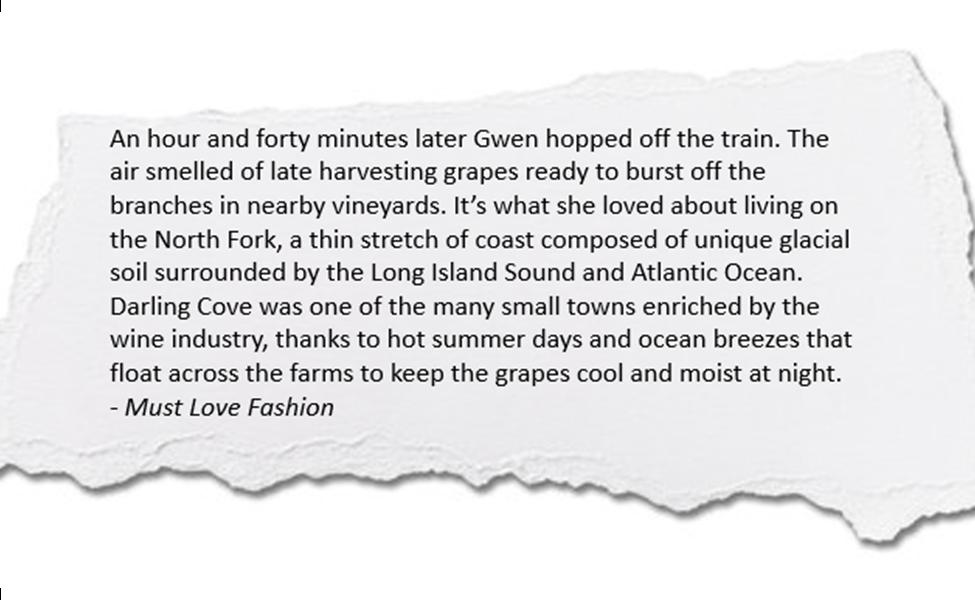
In the first Darling Cove book, Must Love Fashion, I introduce the setting by describing it like
this:
Small town romances, regardless of where they are set are
meant to give the reader a sense that the characters are part of a tight knit
community. For better or worse. While Must Love Fashion, jet-set the reader
from Manhattan to Milan and finally settled down in Darling Cove, Book 2, Must
Have Faith, primarily takes place in the small North Fork town. Faith, the
heroine is a runaway bride who’s come home. Imagine the courage it takes to
face everyone! Not to mention her jilted groom.
Greg and Faith were childhood sweethearts who were on
their way to happy ever after, except Faith got cold feet and took off two days
before the wedding. Greg also has a lot to answer for. He’s the only son in the
Mallory family. A family that stayed close. Real close. His father and his
sisters all live in Darling Cove. So when he and Faith figure out there’s still
so much fire between them, they must do it in front of their family and a small
town that loves wine!
Must Have Faith was really fun to write. And I loved
seeing the whole town of Darling Cove in my head. Here’s some other snap shots
of the North Fork:
This October, the third book in the Darling Cove series, Must
Be Crazy will be released. And in November, because I couldn’t get enough of
Greg and Faith, I will be releasing a novella that extends their story just a
touch. Look for A Must for Christmas.
All of my books (E-books and Paperback) are on Amazon, as
well as Barnes and Noble, iBooks and Kobo.
I am also a Goodreads Author and you can find all the Darling Cove Books
on the GR and Amazon Series Pages (links below).
I would
love to hear from readers. I can be reached via the following:
Twitter:
@deborah_garland
I’m giving away a signed copy of Must Have
Faith! (US only, please)
(all info Author Released and contributed)
 My name is June Trop, author of the Miriam bat Isaac Mystery Series.
  We are a favorite spot in the East for rock climbers,